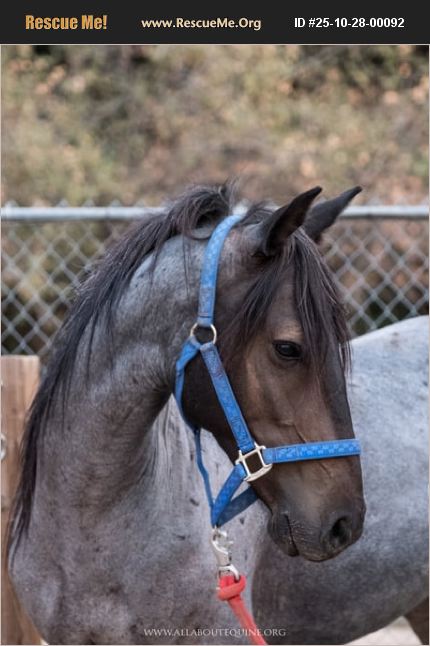
If you are interested in adopting this horse, please submit an Adoption Inquiry via AAE's website; No texts please: https://www.allaboutequine.org/how-to-adopt.html. Adoption fee subject to change based on training; see website for all current information. Blue is a 2010 Virginia Range (NV) mustang gelding who came to AAE March of 2017 after a request for assistance from the Virginia Range Wild Horse Sanctuary and Hidden Valley Wild Horse Protection Fund. Blue had been carrying around a large seven pound mass of proud flesh (granulation tissue) over his left rear fetlock/pastern area for some time. Although he had been haltered and handled some previously, he was not halterable when he arrived at AAE. We knew we had a big job ahead in helping Blue. Before we could evaluate the mass, he had to be gentled, haltered, and readily halterable, and his legs/hooves had to be readily handleable for frequent bandage changes after surgery. With a straightforward mustang, it's usually not a big deal, but Blue had some substantial fear/trust issues. Initial efforts with befriending and haltering him were lukewarm. Thanks to Dr. Stolba and Team at LBEMC (throughout Blue's journey), he had made enough progress that we were able to sedate him, radiograph the bony area beneath the mass, and collect tissue samples for biopsy. We wanted to make sure there was not an underlying reason for the mass other than an old injury before getting too deep into corrective measures if they would be for naught. It was not an easy feat. Even with sedation, he kicked quickly and with purpose. Radiographs and biopsy detected no obvious issues, so the work continued. Weeks in, Blue seemed to have had a reaction to something and developed a mysterious condition that turned out to be a form of vasculitis. He developed sores/ulcers throughout his entire mouth. The first layer of tissue pulled off with any type of pressure. They were horribly painful. Though his history and symptoms didn't suggest it, we had to quarantine him and test him for vesicular stomatitis. Thankfully, it was negative. We scaled back our efforts to reduce his stress and allow him to heal. But, the mass was growing and oozing, and flies and yellow jackets swarmed the oozy mass. After several weeks, he improved and we've resumed course. He would take a few steps forward, then a couple steps back. Finally, after many weeks with nominal results, we had a marathon day. We worked until we broke through. After six hours, he accepted handling and touching all over, and we practiced bandaging and removing bandages, over and over. The next day, our learning curve was much shorter, and the next and the next, until finally, we could halter, touch all over, and pick up his left hind and handle it all over. We practiced with bandaging materials again and wrapped it up, and he was a gem! We scheduled surgery, and in late August 2017, he lost nearly seven pounds in a matter of minutes. The mass had a narrow base and truly looked like a big brain. Imagine what that must have felt like with every move. Needless to say, it was done! However, the mouth lesions returned. There were more and they were worse this time. They were on his body, around his anus, and on his sheath. Poor guy, these things were awful, and they appeared to be an autoimmune issue. At one point, we questioned his prognosis and quality of life, but before jumping to conclusions, we biopsied the tissue. We ended up with the vasculitis diagnosis. The best thing was, we changed up his meds and the sores began to heal. The area where the mass was removed was beginning to heal. In the meantime, the next test came when it was time to change his first bandage. With a bit of sedation, it went fairly smooth, but cleaning the lesion was a little challenging. But wow, it looked amazing! Such a tremendous improvement. It was like a victory in and of itself, even though not healed. Healing progressed nicely! After several bandage changes, Blue was getting resentful of the needle for sedation, so we tried without. It went well with cleaning a few times, but oddly, after a few times, he didn't like it when placing the medicated bandage over the lesion. It seems he was healing, and he could feel the area again. He stomped the bandage off, over and over. The stomp was a little intimidating, but really, he was only trying to get the 'big white bug' off his leg. He didn't kick out or kick at. His stomp was purposeful in knocking the bandage off his leg. Unfortunately, we couldn't keep the bandage on, so we had to go back to sedation for a bit. Eventually, we could remove the bandage, clean the lesion, and replace the bandage without issue, without sedation, thankfully. Healing continued. Please read the rest of Blue's story on our website.

Facebook Share/Comments
We block people who post offensive messages. See a problem? REPORT NOW
Please ✔ check "Also post on Facebook" after typing a question or comment.